Established in 2023, Connect And Thrive (CAT) is Felton Institute’s innovative early childhood mental health program.
CAT is a place-based, early relational health model centering the lived experience of those we serve and focusing on supporting the social-emotional and mental health of children 0-5 years old through interventions that bolster their relational world.
At Felton, we understand that early childhood mental health is not about treating the parent or the child but about treating the relationship between adult and child. Thus, our program model focuses on the bolstering of relationships between young children and the adults who care for them, their at-home caregivers as well as their educators.
CAT is based on the early relational health framework with a focus on promoting high-quality child interactions for our young clients. Rooted in the voices of families, CAT employs a Multi-Tiered Intervention System (MTSS) and a diverse, interdisciplinary team to deliver culturally and linguistically responsive early childhood mental health interventions.
CAT Program Background and Approaches
The Connect and Thrive program goes beyond the conventional approach of many behavioral health programs which focus exclusively on psychotherapeutic services implemented by Master’s level clinicians.
When we surveyed our families in 2021, while they mentioned therapy as a service, they were looking for increased access too, they focused mainly on more traditional and community-level healing practices such as therapy groups and places where they could connect with parents and professionals more informally.
Although psychotherapy is one aspect of the Connect and Thrive program, the program goes beyond this approach, focusing on the tiered implementation of mental health interventions, delivered by masters-level clinicians, Social-Emotional Learning Specialists as well as people with lived experience.
CSEFEL Program Model
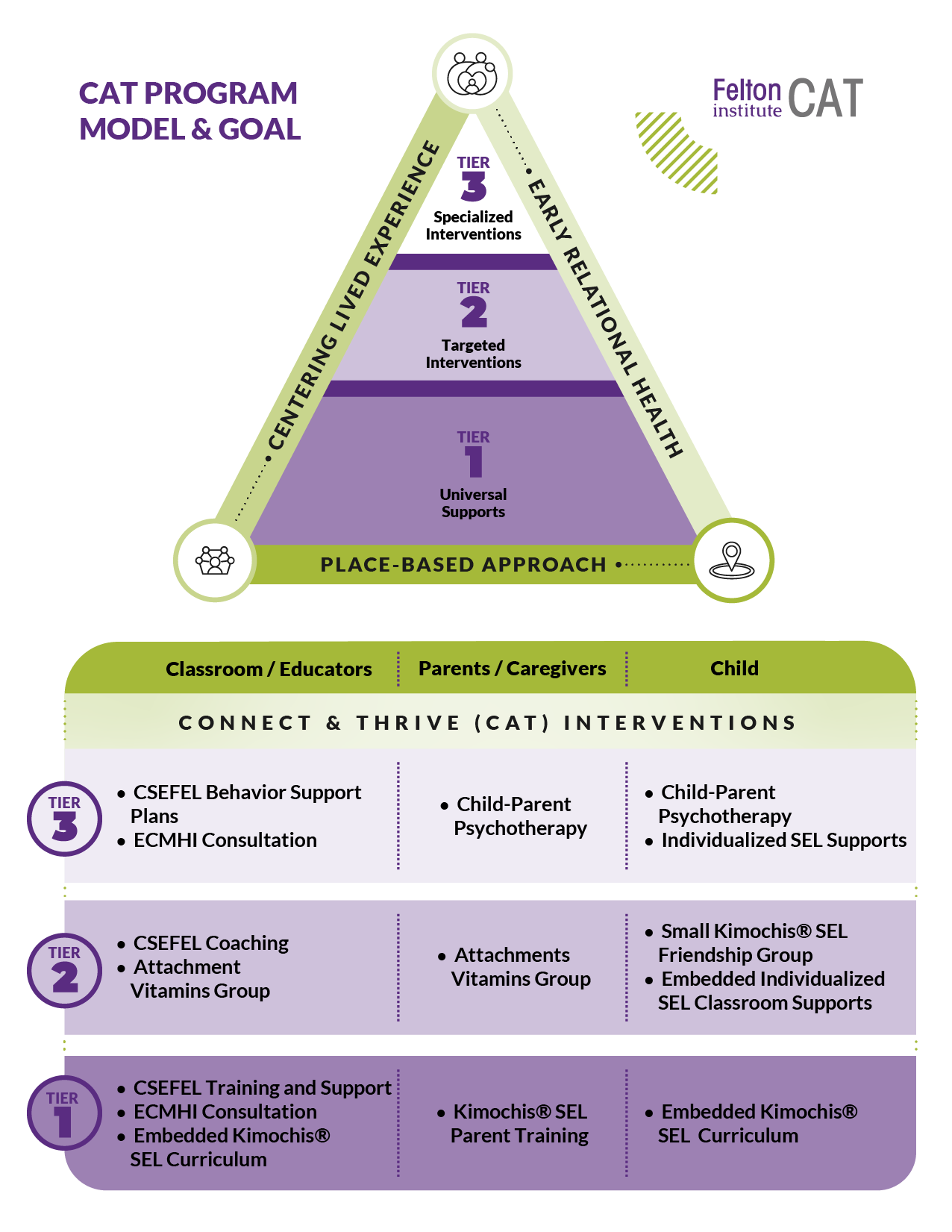
Connect & Thrive (CAT) utilizes the Center on the Social and Emotional Foundations for Early Learning (CSEFEL) teaching pyramid to identify interventions that will respond to the needs of all children.
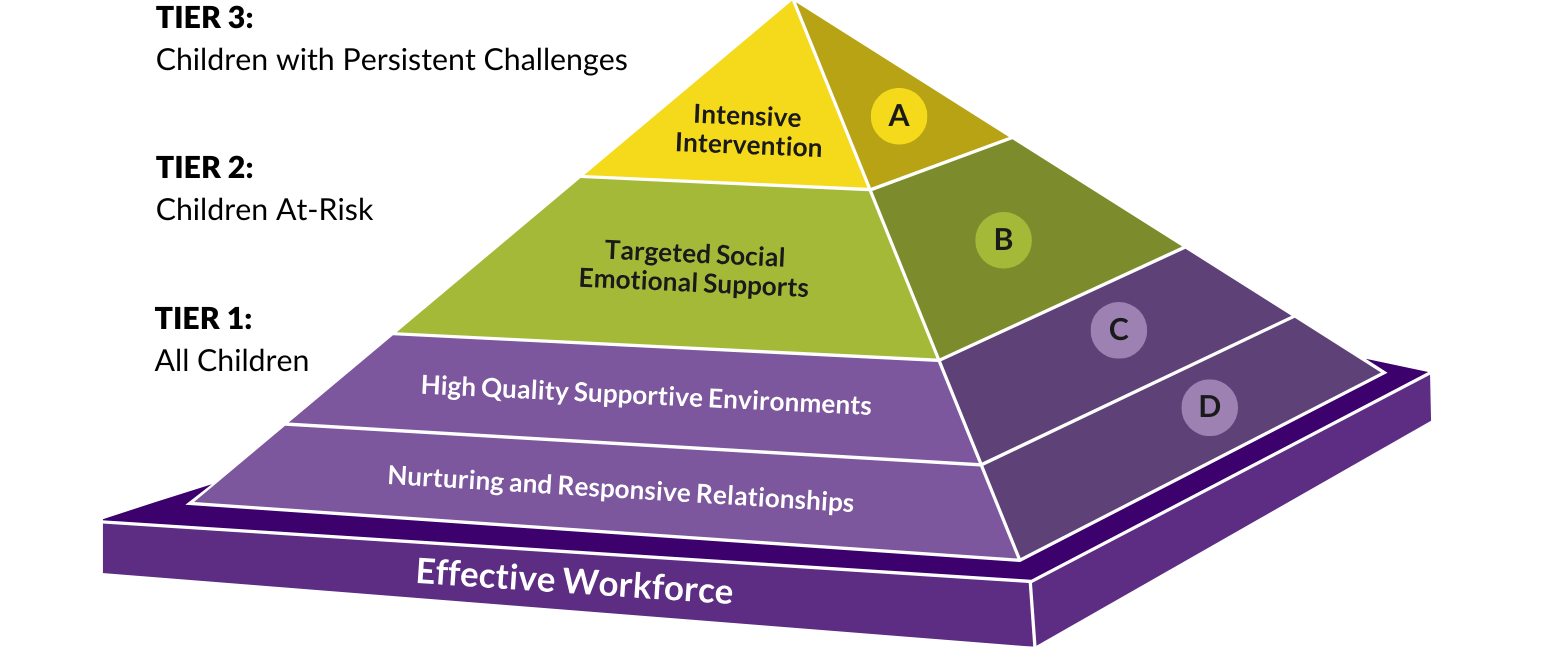
 Assessment based intervention that results in individualized behavior support plans.
 Systemic approaches teaching social skills can have a preventive and remedial effect
 High quality early childhood environments promote positive outcomes for all children
 Supportive responsive relationship among adults and children is an essential component to promote healthy social emotional development
Who We Serve
Our diverse interdisciplinary team provides evidence-informed early childhood mental health interventions to young children aged birth to five years old, who are part of families served through Felton’s Early Care & Education (ECE) and Family Resource Centers.
Program Components
Connect And Thrive (CAT) employs a Multi-tiered System of Support (MTSS) to cater to the varying needs of children:
Tier 1 Interventions: Universal Supports benefiting all children served:
- CSEFEL Teaching Pyramid: A Teacher Training program that supports the integration of early childhood mental health into ECE settings.
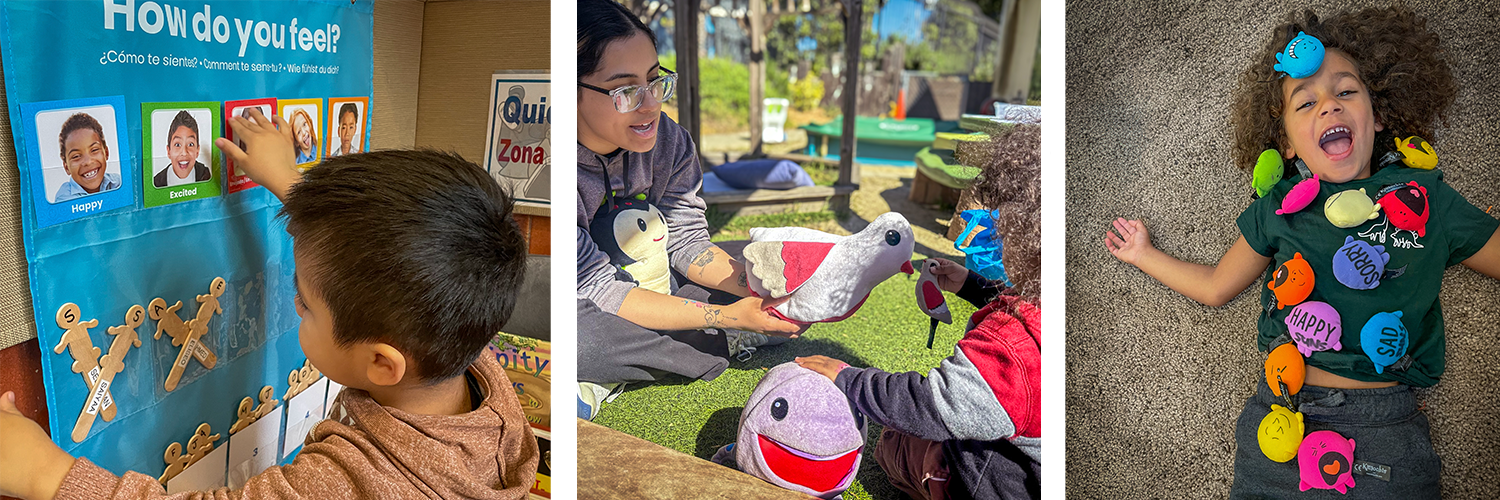
- Kimochis Curriculum: We use the evidence-based Kimochis Curriculum to teach Social Emotional Learning skills to all children served by this model.
Tier 2 Interventions: Targeted Interventions for at-risk children and families:
- Attachment Vitamins Groups: The Attachment Vitamins curriculum is a ten-week group psychotherapy model that supports caregivers of young children by teaching concepts of early childhood attachment in a non-judgmental, reflective group therapy setting. Felton provides this group therapy model to selected caregivers and educators who could benefit from this content and reflection time to deepen their learning.
- Friendship Groups: These small social skills groups support young children who require additional practice and teaching related to social skills. These groups happen on location at our ECE sites, with activities and goals being sent home to caregivers. The groups include children who are “at risk” and need additional support, as well as children pulled from our general ECE population to act as “peer models.”
Tier 3 Interventions: Specialized support for children recovering from trauma:
- Child-Parent Psychotherapy: We provide on-site psychotherapy to young children and families impacted by trauma using the evidence-based Child Trauma Psychotherapy (CPP) model. CPP is conducted by our Child and Family Clinicians
- 1:1 Social Emotional Learning Supports: We provide individualized support for children with behavioral challenges by providing in-classroom, individualized support to the children as well as coaching and training for their teachers 1:1 Social Emotional Support is provided by our Social Emotional Learning Specialist (SELs).
Program Models
Terms Defined:

Place-Based: Our model incorporates place-based approaches that target a defined geographic area and take an ecological perspective, addressing individual, family, and community-level issues. The approach focuses on the unique needs, assets, and characteristics of those served in this demographic area. The services aim to enhance the quality of life and address local issues by leveraging local resources, engaging community members, and coordinating efforts.
Early Relational Health: Our model incorporates early relational health which is the state of emotional well-being that grows from the positive emotional connection between children and their parents/caregivers when they experience strong, positive and nurturing relationships with each other.
Centering Lived Experience: Our model incorporates and is centered on the lived experience of those we serve through an equity lens, which means not just listening to, but acting on, the knowledge and expertise of those most affected by the inequities, ensuring that their authentic voice, agency, and insights lead to tangible changes and improvements in systems and structures.
Program Goals
The overarching goal of Felton’s Connect And Thrive (CAT) program is to support the social-emotional and mental health wellness of Felton children ages 0-5 through bolstering the relational health of children both at school and at home. We do this through a Multitiered System of Support utilizing evidence-based mental health interventions directed at children, families, and our ECE educators that address every level of need in our community.
-
- Go beyond conventional therapeutic methods to treat the unique needs of families.
- Create a sustained and interconnected approach to supporting families’ health and wellbeing.
In addition to the overarching goal listed above, we have the following sub-goals that align with our Multi-Tiered System of Support:
-
- To enhance the social-emotional development of young children 0-5 by giving them the skills to understand and respond to their emotional states.
- To enhance support for at-risk children and families by increasing the knowledge of early childhood attachment amongst caregivers and adults who work directly with children.
- To aid in trauma recovery for children and caregivers who have experienced trauma with supportive, evidence-based mental health interventions targeted the individual children as well as the caregivers who interact with them.
Who We Are
The Connect And Thrive (CAT) Team comprises dedicated professionals committed to the well-being of children and families:
- Clinical Director: Licensed Clinician with a specialty in Early Childhood Mental Health who oversees all administrative and clinical aspects of the program.
- Social Emotional Learning Specialists with specializations in Early Childhood Development and Social-Emotional Learning who support children with high social-emotional needs, run Kimochis workshops and groups.
- Child and Family Clinicians: Bilingual Master-Level clinicians who provide group, family, and individual treatment as well as Early Childhood Mental Health Consultation.
- Parent Fellows: Bilingual/Bicultural parent fellows who support leading parent groups.
Our Location
Connect And Thrive (CAT) services are available at Felton’s Early Care & Education (ECE) centers and the onsite Resource Centers, including Felton's Family Resource Centers, providing accessible care to families across San Francisco.
Program Linkage or Referral
Our program isn't confined to individual child interventions; we intervene in the lives of all individuals surrounding the child, including family members, teachers, and the community.
We provide referrals and linkages to ensure holistic support for families.
Please fill out our referral form to refer clients to our psychotherapy services.
Apply for our Clinical Internship!
Child-Parent Psychotherapy Brochure (PDF)
Both child and caregiver participate in therapy together. Sessions are with child, caregiver and therapist.
Psicoterapia de Niños y Padres Folleto (PDF)
El niño y el cuidador participan juntos en la terapía. Las sesiones incluyen el niño, el cuidador y el terapeuta.
GENERAL CONTACT INFORMATION
Hours (Mon-Fri): 8:30 AM – 5:30 PM
Evening programming by appointment only.
Connect And Thrive (CAT)
Main Office Address: 2730 Bryant Street, 1st Floor, San Francisco, CA 94110
Main Office Phone: (415) 282-1090, ask for the CAT program
Fax: (415) 282-1735
Program Email: [email protected]
For more information, please contact:
Yohana I. Quiróz, Ed.D., Felton Institute Chief Operations Officer (COO),
Children, Youth, Family and Transitional Age Youth Services (CYFTAY)
Email: [email protected]